Make Your Own Money: The Underground Playbook for Building a Creative Life Without Asking Permission
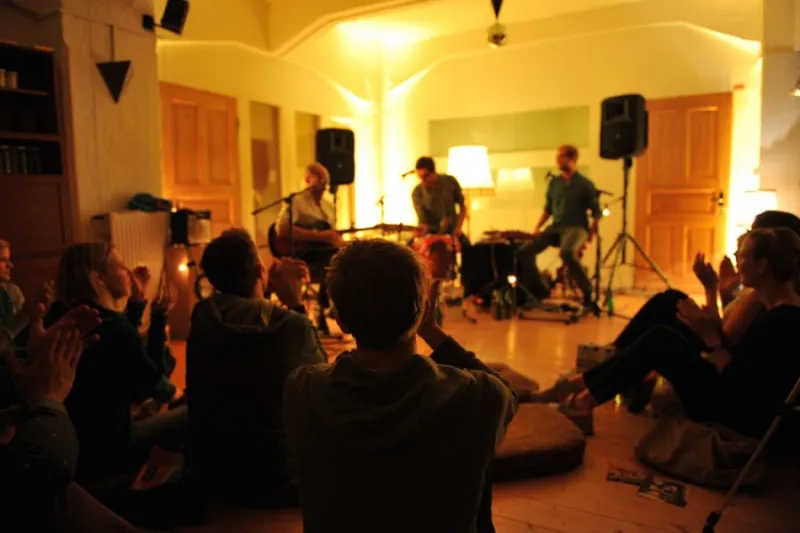
Photo: independent musician performing intimate house concert living room audience, via flypaper.soundfly.com
Let's start with a number: $847.
That's what singer-songwriter Priya Mehta made in her first month running a direct-to-fan subscription through a simple email list, before she'd ever heard of Patreon, before she had a publicist, and before any algorithm decided she was worth amplifying. She'd been playing music for eight years. She'd applied for three grants and gotten none of them. She'd sent demos to labels and gotten back form rejections or silence.
Then she asked her 200 most loyal fans to pay her $5 a month for early access to demos, handwritten lyric sheets, and a monthly voice memo where she talked about what she was working on.
"I felt embarrassed asking," she admits. "Like I hadn't earned it yet. But 169 people said yes in the first two weeks. That changed everything I thought I knew about how this was supposed to work."
Priya's story isn't unique. Across music, visual art, writing, craft, and performance, a generation of American creators has quietly built a parallel economy — one that doesn't require a grant committee's approval, a label's investment, or an institution's blessing.
The Old Model Is Broken (And It Was Never That Great)
Here's what the traditional path looked like: spend years developing your craft, apply for grants (most of which go to artists who already have institutional credibility), hope a label or gallery or publisher discovers you, sign a deal that gives them most of the money and most of the control, and then spend the rest of your career trying to claw back your own autonomy.
For a small number of artists, that path worked. For the vast majority — particularly artists of color, artists in rural areas, artists working in genres or mediums that don't fit neatly into fundable categories — it didn't.
"The grant system was never designed for people like me," says muralist and community artist DeShawn Holloway, who works primarily in Birmingham, Alabama. "It was designed for people who already knew how to write grant applications in the language that grant committees respond to. That's a skill set that's not evenly distributed."
DeShawn now funds his work through a combination of community commissions, a paid workshop series, and a sliding-scale print shop he runs out of his studio. Last year was his most financially stable year as an artist. He hasn't applied for a grant in three years.
Micro-Patronage Is Not a Side Hustle — It's Infrastructure
The rise of platforms like Patreon, Substack, and Bandcamp has made direct-to-fan economics more accessible, but the smartest creators aren't just using these tools — they're using them strategically, as part of a diversified financial architecture.
Chicago-based experimental musician and sound designer Luz Vargas runs what she calls a "three-legged stool" model: one-third of her income comes from a Patreon with 340 patrons at an average of $8/month, one-third from sync licensing her music to independent filmmakers and podcast producers, and one-third from teaching private sound design workshops to other musicians.
"None of those three legs would be enough on its own," she says. "But together, they give me stability. If one has a bad month, the others hold me up."
The key insight here is diversification — the same principle a financial advisor would give to any investor, applied to creative income. Dependency on a single revenue stream, whether that's a label deal or a single grant or one client, is fragility. Multiple smaller streams, each serving a different part of your audience or skill set, is resilience.
Touring Without a Booking Agent (Yes, Really)
For musicians, touring has traditionally required either a booking agent (who takes 10-15% and typically won't work with artists below a certain draw) or grinding cold emails to venues that mostly ignore you.
A growing network of DIY touring collectives is changing that equation. House concert networks, cooperative booking clubs, and regional artist alliances are creating infrastructure that lets independent musicians route tours through living rooms, community centers, record stores, and art spaces — bypassing traditional venues entirely.
Raleigh-based folk duo The Briar Pickers did a 22-date tour last spring entirely through a house concert network they'd spent two years building through social media and word of mouth. Average door take per show: $340. No booking agent fee. No venue cut beyond a small hospitality contribution to the host.
"We made more money on that tour than we did on a 15-date club tour we did the year before," says one half of the duo, Sam Whitfield. "And the shows were better. People came because they actually wanted to be there, not because they happened to be at the bar."
Skill-Sharing as Currency
One of the more quietly radical funding models emerging in creative communities is the skill-share economy — artists trading expertise rather than (or in addition to) money.
In practice, this looks like: a graphic designer trading branding work for six months of music lessons. A ceramicist offering a workshop to a community space in exchange for studio access. A photographer trading portrait sessions for copywriting on their website.
"Money is one way to exchange value, but it's not the only way," says Priya, who now regularly trades production sessions with other independent musicians. "When cash is tight, skills are liquid."
This model also builds community in ways that purely transactional relationships don't. The network you build through skill-sharing is a network of people who've worked alongside you, who understand your craft, and who are invested in your success because you're invested in theirs.
The Collective Advantage
Some of the most financially stable independent artists aren't operating alone — they're operating as collectives, pooling resources, sharing costs, and presenting a larger face to the world than any one of them could manage individually.
A four-person visual art collective in Denver that asked to be identified only as "the group" shares a studio space (splitting a $1,800/month lease four ways), coordinates joint grant applications (increasing their competitiveness for institutional funding they'd struggle to access individually), and runs a shared online store where each artist's work is presented under the collective umbrella.
"Together, we look like an organization," one member explains. "Separately, we look like four struggling artists. The world responds to organizations."
What This Requires (Honestly)
None of this is easy, and it would be dishonest to make it sound like it is. Building alternative funding infrastructure requires time, energy, and a willingness to learn skills — marketing, financial planning, community building — that most art education programs never teach.
It also requires a tolerance for uncertainty that not everyone has equal access to. Artists with financial safety nets, supportive families, or partners with stable income can take risks that artists without those cushions can't.
"I want to be real about the privilege piece," says DeShawn. "I could afford to stop applying for grants because I had a few thousand dollars in savings that gave me runway to try something different. Not everyone has that."
The goal isn't to romanticize hustle or pretend the system is fair. It isn't. The goal is to map the terrain as honestly as possible so that more artists can navigate it — and to keep pushing, collectively, for a world where creative people don't have to become entrepreneurs just to survive.
The Permission You're Waiting For
Priya's subscriber list is at 1,400 people now. She put out an album last year with no label, no distributor, and no PR firm. She made her recording costs back in 72 hours.
"I used to wait for someone to tell me I was ready," she says. "I don't do that anymore. I just ask the people who already care about my work to support it. Most of the time, they do."
That's the whole playbook, really. Stop asking institutions for permission. Start asking your community for support. Build the infrastructure, slowly and deliberately, that lets you keep making the work.
It's not a guarantee. But neither was the old way.