Smaller on Purpose: The Creators Who Chose Their Audience Instead of Chasing One
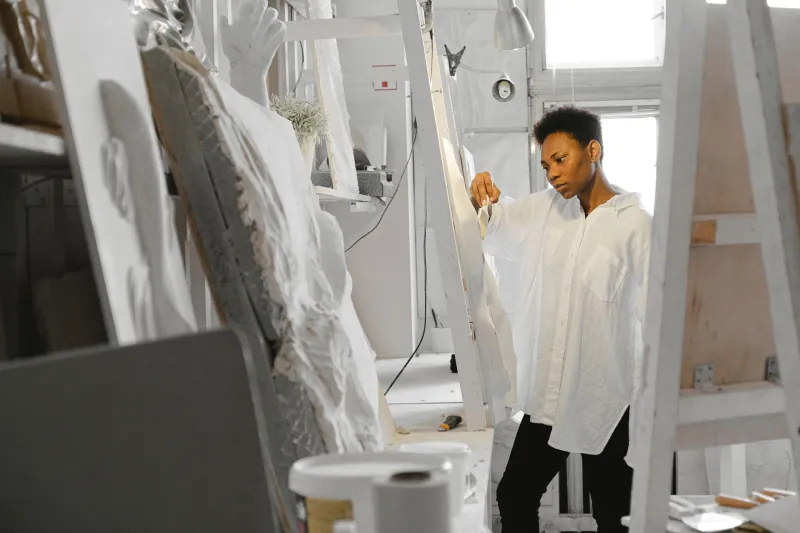
There's a particular kind of exhaustion that sets in when you've spent months — maybe years — feeding an algorithm. You post at the right times. You use the trending sounds. You write the hooks that are supposed to stop the scroll. And sometimes it works, a little. But the people who show up feel like strangers at someone else's party. They came for the trick, not for you.
A quieter, more stubborn cohort of creators is pushing back on all of it. Not with manifestos or dramatic "I'm quitting social media" announcements, but just by... not playing the game. They're building audiences of dozens, hundreds, maybe a few thousand — on purpose, with intention — and they're finding something that the viral-or-bust crowd rarely talks about: actual creative satisfaction.
The Myth of More
The cultural assumption baked into nearly every platform — from Instagram to Spotify to Substack — is that bigger is better. More followers, more streams, more subscribers. The metrics are always pointed in one direction: up. And because those numbers are public, they become proxies for worth. A painter with 300 Instagram followers feels, by design, like less of a painter than one with 30,000.
But what if the 300-follower painter is selling work consistently to people who genuinely love it, getting commissions from collectors who found her through word of mouth, and actually enjoying the process of making things? That story doesn't show up in a dashboard anywhere. It doesn't make for a satisfying case study. But it's happening, constantly, in studios and living rooms and community spaces across the country.
Marika, a textile artist based in Albuquerque, New Mexico, spent two years trying to grow her online presence before deciding to stop. "I was making work for the caption," she says. "Like, I'd finish a piece and immediately start thinking about how to photograph it for maximum engagement. That's a horrible way to make art." She deleted her TikTok, scaled back her Instagram to occasional personal posts, and started a small email list for people who specifically asked to hear from her. She now has 412 subscribers. She's never been busier with commissions.
Depth Over Breadth
There's a term that keeps coming up in conversations with creators who've taken this path: depth. Not depth as in complicated or inaccessible, but depth as in real relationship — the kind where someone actually cares what you make next because they've been paying attention for a while.
This is fundamentally different from an audience that found you through a viral moment. Viral audiences are fickle by nature — they showed up because something caught their eye, not because they're invested in your creative trajectory. A smaller, intentionally cultivated audience tends to be more forgiving when you experiment, more likely to share your work with people they know personally, and more willing to actually pay for what you make.
Domingo, who runs a weekly music and culture newsletter out of Chicago focused on Latin alternative sounds, has about 900 readers. He turned down an offer to partner with a larger media platform that would have boosted his subscriber count significantly. "They wanted me to cover certain artists, write in a certain format, hit certain topics because they were trending," he explains. "That's not what my readers signed up for. I'd be trading the thing that makes this worth doing for a number that looks good on a pitch deck."
His newsletter has a consistent open rate that would make most media companies envious. He knows several of his readers personally. Some have become collaborators. That's not an accident — it's the result of treating an audience like a community rather than a metric.
The Psychological Upside Nobody's Talking About
Here's something the content-creator industrial complex doesn't advertise: the constant pursuit of algorithmic growth is genuinely bad for your mental health. The dopamine loop of checking analytics, the anxiety of posting into the void, the creeping sense that your worth as a creative person is tied to a follower count — none of that is neutral. It costs something.
Creators who step away from that loop describe a shift that's almost disorienting at first. The silence where the notifications used to be. The strange freedom of making something without immediately broadcasting it. And then, slowly, the return of something they'd almost forgotten: curiosity. The ability to make a thing just to see what happens, without a growth strategy attached.
Rowan, a visual artist and occasional muralist in Portland, Oregon, describes it as "making work in your own timezone again." After years of trying to stay relevant on social platforms, she shifted her energy toward in-person community — open studio nights, collaborative projects with local organizations, a small Patreon where she shares process work with about 150 paying supporters. "I stopped feeling like I was performing creativity and started actually doing it," she says.
What 'Success' Gets to Mean
The creators taking this path aren't anti-ambition. They're redefining what ambition looks like. Instead of chasing scale, they're chasing sustainability — the ability to keep making things, keep connecting with people who care, and keep paying the bills without selling out the core of what they do.
This means different things for different people. For some, it's a small Patreon or Substack that covers studio costs. For others, it's a local following that fills a show or buys a print run. For others still, it's simply the knowledge that the work they're making is landing with the right people, even if those people are few.
None of this is easy to quantify. It won't show up in a case study about "creator economy success." But if you ask the people doing it, they'll tell you it feels more like art and less like content — and that distinction, for a lot of them, is everything.
The Bonsonno Take
We're drawn to this movement at Bonsonno because it rhymes with something we believe pretty deeply: that culture gets richer when it's made with care rather than with reach in mind. The most interesting things happening in art and music and community right now are often happening in small rooms, quiet inboxes, and hyper-local networks that no algorithm will ever surface.
You don't have to go viral to matter. You just have to find the people who are genuinely listening — and then actually talk to them.