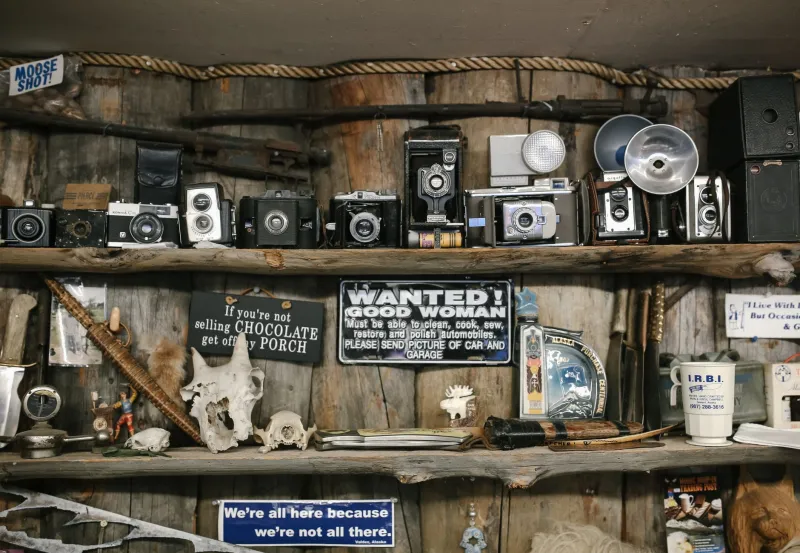
Somewhere in Albuquerque, New Mexico, a retired school bus driver named Terrence has converted his two-car garage into a fully catalogued archive of regional lowrider culture — flyers, photographs, hand-painted plaques, and even a few original hydraulic pump schematics from the 1970s. He doesn't charge admission. He doesn't have a grant. He does have a folding table, a label maker, and an absolutely unshakeable conviction that this stuff matters.
"Nobody was saving it," he says. "So I just started."
Terrence isn't alone. All across the US, a quiet and slightly chaotic movement is reshaping who gets to decide what counts as cultural history. Collectors, hobbyists, and flat-out obsessives are transforming their personal stashes into something that functions — sometimes accidentally, sometimes very much on purpose — like a public institution. Except messier. And way more interesting.
The Stuff No One Else Wanted
Here's the thing about mainstream museums: they're selective in ways that tend to reflect who's been doing the selecting. Punk zines from 1983. Regional wrestling promotion posters. Hand-sewn banners from queer community events in mid-sized cities. Cassette tape artwork from bedroom hip-hop producers in the mid-90s. This is the kind of material that slips through institutional cracks not because it lacks value, but because the institutions never developed the vocabulary — or the will — to appreciate it.
That vacuum is exactly where the accidental curators have moved in.
In Portland, a woman named Deja has spent over a decade collecting Black hair care ephemera — product packaging, salon appointment cards, trade show programs, advertisements from Black-owned newspapers going back to the 1940s. What started as a nostalgic hobby became, in her words, "a whole project I didn't plan for." She now maintains a digital archive with over 2,000 items, cross-referenced and publicly searchable, that researchers from universities have actually cited in academic papers.
"I never thought of myself as doing anything scholarly," she laughs. "I just thought the stuff was beautiful and nobody was keeping it."
When the Living Room Becomes the Gallery
Some collectors have gone further than a website. They've physically opened their spaces.
In Chicago's Pilsen neighborhood, a former screen printer named Marcus has turned the front room of his apartment into what he half-jokingly calls "the museum of stuff that almost got thrown away" — a rotating display of Chicago underground music ephemera, from early house music event flyers to hand-dubbed mixtape covers. He hosts open hours twice a month, usually on Saturdays, and word has spread enough that he's had visitors come from out of state.
His collection policy is straightforward: if someone in the community made it, and it reflects a moment that isn't otherwise documented, it belongs here. Full stop.
"I'm not trying to be the Smithsonian," Marcus says. "The Smithsonian isn't going to do this. That's why I am."
This DIY institutional logic — filling gaps that formal culture has decided aren't worth filling — is the connective tissue running through all of these projects. They're not anti-museum, exactly. They're post-museum. They exist in the space institutions left behind.
The Digital Basement
Not every accidental curator has the square footage for a physical space. For many, the archive lives online — and in some ways, that's made the collections even more accessible.
A collector in Austin who goes by Roz has spent years building an Instagram archive dedicated to vintage feminist punk show flyers from the late 80s and 90s, with a particular focus on the Southwest and Pacific Northwest. What started as a personal scrapbook has turned into a community hub with tens of thousands of followers, many of whom have contributed their own scans and photos.
"People DM me constantly with stuff I've never seen before," Roz says. "The archive is crowdsourced at this point. I'm just the person maintaining the folder."
That collaborative model is increasingly common. The accidental curator becomes a kind of gravity well — their visible passion attracting others who've been sitting on their own fragments of the same story, waiting for somewhere to put them.
The Question of Preservation
There's a real tension lurking underneath all of this, and the collectors know it. Personal archives are fragile. They depend on the health, finances, and continued enthusiasm of one or two people. What happens when Terrence can't maintain the garage anymore? What happens to Deja's digital archive if the hosting service changes its pricing model?
These aren't abstract concerns. Several collectors mentioned losing chunks of their digital work to platform shutdowns or technical failures. Physical collections are vulnerable to floods, fires, and the brutal logistics of what happens to someone's stuff after they die.
Some are taking steps. Deja has been in conversations with a historically Black university about potentially donating or co-stewarding her archive. Marcus has started training a small rotating group of neighborhood volunteers in basic preservation techniques — acid-free sleeves, proper storage temperatures, the whole thing.
But most are just doing their best with what they have. Which, honestly, is how most of cultural history has always been saved.
Why This Matters Right Now
There's something worth sitting with here. At a moment when institutional trust is shaky and cultural gatekeeping is being questioned from every direction, these informal archives feel genuinely radical. Not because they're trying to be — most of their creators would probably laugh at that framing — but because of what they represent: the idea that cultural memory doesn't have to be mediated by a board of directors or a grant committee.
Anyone with enough obsession and a little bit of shelf space can decide that something matters and act accordingly.
That's not a small thing. In fact, it might be exactly the kind of energy that keeps the weird, the specific, and the overlooked from disappearing entirely.
Terrence put it simply when asked why he keeps doing this, year after year, with no funding and no institutional backing.
"Because in fifty years," he said, "somebody's going to want to know this existed. And I want them to be able to find it."
Hard to argue with that.