Burn After Reading: The Communities That Delete Themselves on Purpose
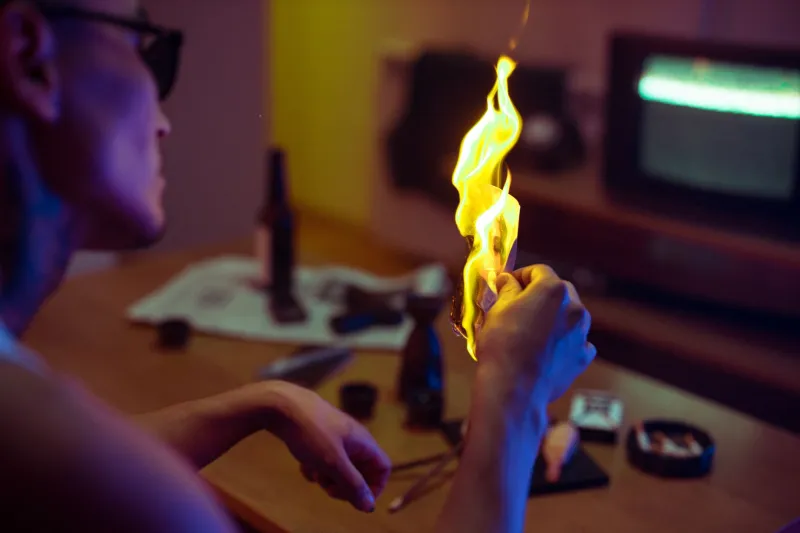
There's a show happening tonight in a warehouse somewhere outside of Cleveland. No photos allowed. No live-tweeting. No tagging the venue. By tomorrow morning, the organizers will have deleted the event page, shredded the flyers, and asked everyone who attended to let the memory live only in their heads.
This isn't paranoia. It's a policy.
Across the country, a loose but growing network of artists, organizers, and community builders are making a deliberate, sometimes startling choice: they are refusing to document what they do. More than that, some are actively destroying evidence that they ever did it at all.
The Archive Is a Trap
We live in a moment that treats documentation like oxygen. Post it or it didn't happen. Screenshot everything. Build a portfolio. Grow your archive. The cultural pressure to capture, catalog, and preserve every creative gesture has become so normalized that opting out feels almost transgressive.
Which is exactly why some people are doing it.
"The archive is a control mechanism," says one organizer who runs a monthly sound art event in Philadelphia — and who asked not to be named, for reasons that will become obvious. "Once something is documented, someone else gets to decide what it means. The institution, the algorithm, the critic. We lose authorship the second we hit record."
This isn't a fringe position. Philosophers, archivists, and media theorists have long debated who documentation actually serves. But where academics argue in journals, these communities are living the answer out loud — and then burning the transcript.
Presence as the Point
For many of these groups, impermanence isn't a side effect of their practice. It's the whole practice.
A queer art collective in the Pacific Northwest holds what they call "disappearing shows" — gallery-style exhibitions that run for a single afternoon in unmarked spaces. The work gets made, displayed, and then either destroyed or dispersed to attendees. Nothing is photographed. Nothing is sold. The only people who experience it are the ones who showed up.
"We're not interested in legacy," one of the collective's founders explained in a rare written statement shared directly with Bonsonno. "Legacy is for institutions. We're interested in the people in the room right now."
That framing — presence over posterity — keeps coming up in conversations with communities doing this work. There's a belief that documentation fundamentally changes what a thing is. That the moment you introduce a camera, you've shifted the energy from participation to performance. The audience becomes subjects. The experience becomes content.
And content, as everyone knows by now, gets extracted.
Protecting the Vibe (and the People)
There's also a harder, more practical reason some communities are choosing to go undocumented: safety.
Undocumented immigrant artists. Queer youth in hostile family situations. People in recovery who don't want their presence at certain events searchable. Activists whose attendance at gatherings could be used against them. For these communities, the decision to destroy records isn't philosophical — it's protective.
"We had people coming to our events who genuinely could not have photos of themselves in certain spaces circulating online," says a Detroit-based organizer who runs underground wellness and music nights. "So we stopped taking photos. And then something weird happened — the events got better. People relaxed. They stopped performing for each other."
This accidental discovery keeps surfacing. The camera-free, archive-free environment doesn't just protect vulnerable attendees — it transforms the social texture of the space itself. People dance differently. Talk more honestly. Take risks they wouldn't take if they thought someone was watching.
What Gets Lost
It would be dishonest not to name the tension here. Archival destruction isn't without cost.
Historically, the communities whose cultures have been most aggressively undocumented — by force, by neglect, by systemic erasure — are communities of color, queer communities, working-class communities. The argument that documentation is a form of extraction carries real weight. But so does the countervailing grief: how much cultural history has already been lost because no one thought to preserve it?
Some organizers sit with that tension explicitly. "I know what it feels like to search for evidence of your people and find nothing," says one Chicago-based artist who runs an Afro-futurist collective. "So we do document internally. We keep records for ourselves. But we decide who gets access, and we decide when it disappears. That's different from handing it over to the internet."
This points to a distinction worth making: there's a difference between controlled, community-held documentation and the kind of ambient, public, algorithmically-sorted documentation that social media demands. Some groups are choosing the former and refusing the latter. The archive exists — it's just not yours to search.
The Bonsonno Angle
What draws us to this movement at Bonsonno is the way it forces a question we don't ask often enough: Who is culture actually for?
If the answer is "the people in the room," then maybe permanence is beside the point. Maybe the most generous thing a community can do is create something extraordinary and then let it go — refusing to turn it into content, into a brand, into a legacy project that outlives the relationships that made it real.
There's something almost spiritual about it. The Buddhist concept of anicca — impermanence as a core feature of existence, not a bug — feels relevant here. The sand mandala that monks spend weeks constructing before brushing it away. The Japanese tradition of mono no aware, the bittersweet awareness of passing things. These aren't traditions of nihilism. They're traditions that locate meaning in the moment of experience, not in its preservation.
American culture, by contrast, is deeply allergic to forgetting. We build museums, maintain archives, digitize everything. There's obvious value in that. But there's also something it costs us — a willingness to be fully present in experiences that won't be remembered by anyone who wasn't there.
Let It Go
The warehouse in Cleveland will be empty by the time you read this. The flyers are gone. The event page is deleted. The people who were there are carrying something that won't show up in any search result.
Maybe that's the point. Maybe some things are only meaningful because they can't be indexed.
The communities choosing to burn their archives aren't rejecting history. They're arguing about who gets to hold it — and deciding, for once, that the answer is them. Not the platform. Not the institution. Not the algorithm that will eventually sort their memories into a highlight reel.
Just the people who were in the room.
And honestly? That sounds kind of beautiful.